

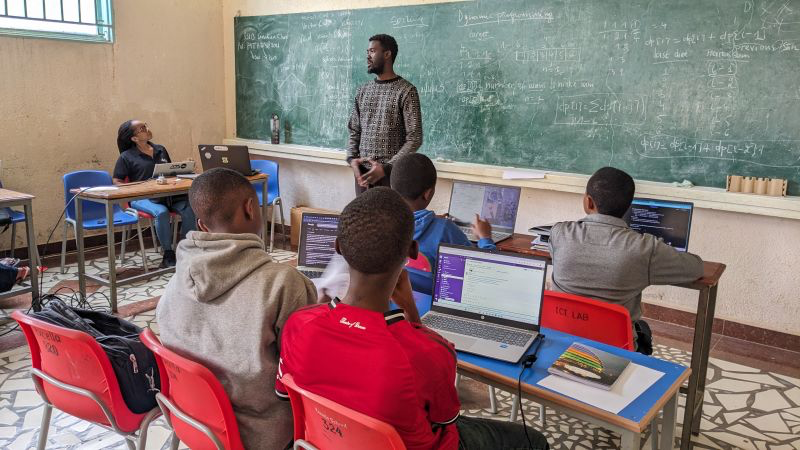
On a September Saturday, when school would normally be closed, 66 secondary students in 14 countries across Africa and beyond entered classrooms. Each took their seat in front of a computer. Original problems had been devised by a global team of experts. Latency had been checked for each site to ensure fairness. Proctors monitored video feeds to safeguard the competition’s integrity. The Olympiad felt well-established — but almost everything behind it was new.
In 10 hours over two days, the students took on eight of the most demanding algorithmic problems high schoolers face, testing creativity, technical knowledge, and execution. For many, it was the first opportunity to compete against some of the continent’s best young informatics talent.
This was the first Pan-African Informatics Olympiad, which took place in September 2025. The second PAIO has just started in Rwanda, now with nearly half the teams gathering in person. As the competition gets underway, it’s worth taking a look at how this Olympiad was born – going from idea to virtual competition to hybrid in-person event in under two years.
Why does this matter? Computer scientists and engineers are inventing the future, and countries that want to develop and have a say in future computational technologies need to nurture them. Informatics Olympiads give rising students access to the advanced problem-solving and competition experience — and communities of peers and mentors — that help develop their talent. Research shows that exceptional performance in international science Olympiads is a powerful early predictor of who will later advance the knowledge frontier.
Yet access to these opportunities remains highly uneven across Africa. Only 13 African countries have ever participated in the International Olympiad in Informatics (IOI), and only five have participated consistently over the past decade — Egypt, Morocco, Nigeria, South Africa, and Tunisia.
But Africa’s informatics Olympiad ecosystem is primed for growth. Algeria and Rwanda have both joined the IOI in the last three years, while Libya returned to the competition for the sixth time in 2025. Many more are setting up national competitions and joining PAIO.
In 2024, the IOI was hosted on the shores of the Mediterranean in Alexandria, Egypt. Returning to the continent for the first time in 16 years, it inspired young African computer science students and made it more affordable for teams and leaders from across the region to attend.
Among them was Joel Lee, who was serving as Rwanda’s observer – an official attendee preparing for the country’s inaugural participation in IOI the following year. While there, he also connected with team leaders from across Africa.
To harness the enthusiasm of Alexandria, Joel and team leaders from Algeria, Morocco, Nigeria, Rwanda, and South Africa banded together on WhatsApp, naming their group “IOI (Africa).” Early leaders in the group included Hirwa Arnold, a Rwandan and an alumnus of GTF’s Olympiad coaches training, and Arun Shanmuganathan, a co-founder of the African Olympiad Academy, a GTF Olympiad grantee which would become PAIO’s host.
Joel and I had met while working on coach training and strategy for the newly formed Rwanda Computing Olympiad, another GTF grantee, and he included me in the IOI (Africa) group as well.
The exchanges in the group chat made it clear that there was both demand and capacity for an African regional informatics competition. A breakthrough came early in 2025 when Maya Chouikrat, a GTF Coaches alumna from Algeria, shared that she was organizing a new, virtual North African Olympiad in Informatics (NAOI), to be held that April (learn more in our profile of Maya).
With the nascent 10-country NAOI as a model, the next step was to establish a competition open to the entire continent. In February 2025, a Rwanda-based team led by Arun, Hirwa, Joel, and another GTF Coaches alumnus, Kagaba Etienne, shared their initial proposal with the IOI (Africa) group. After a swift commitment by the other countries’ teams to participate, the competition was set for September 2025, exactly one year after the conversation started.
Not shying away from a challenge, the group paired their tight timeline with an ambitious goal – to build a rigorous Olympiad matching peer competitions in Asia and Europe in both challenge and participation. Now it had to deliver.
It was time to grow the team. Modeling themselves on the organization of the IOI, they started by creating an International Committee. The main organizing body of PAIO, it included leaders from Algeria, Nigeria, and Rwanda, chaired by Hirwa.
Next, they created an International Scientific Committee of computer science experts to ensure the quality of the competition and the originality and difficulty of the problems. Informatics leaders from around the world stepped up to serve, like Dr. Pedro Paredes, a Princeton lecturer, IOI medalist and Portugal team coach, and advisor to the Rwanda Computing Olympiad.
Medalists from the IOI and coaches from China, Romania, Syria, Poland, and Ukraine rounded out the Scientific Committee. They got to work curating original algorithmic tasks, solvable in C++ or Python, from submissions by the global competitive programming community.
An International Technical Committee handled platform development, security, data processing, and customization of open-source competition management systems. The day-to-day activities, such as getting teams onboard and implementing monitoring and integrity measures to ensure the competition would be fair, were handled by the Local Organizing Committee, based at the African Institute for Mathematical Sciences (AIMS) in Rwanda.
“Many African countries do not yet have established competitive programming competitions or Olympiad programs, so creating awareness and encouraging participation requires significant effort,” says local organizer Norbert Ndayisenga.
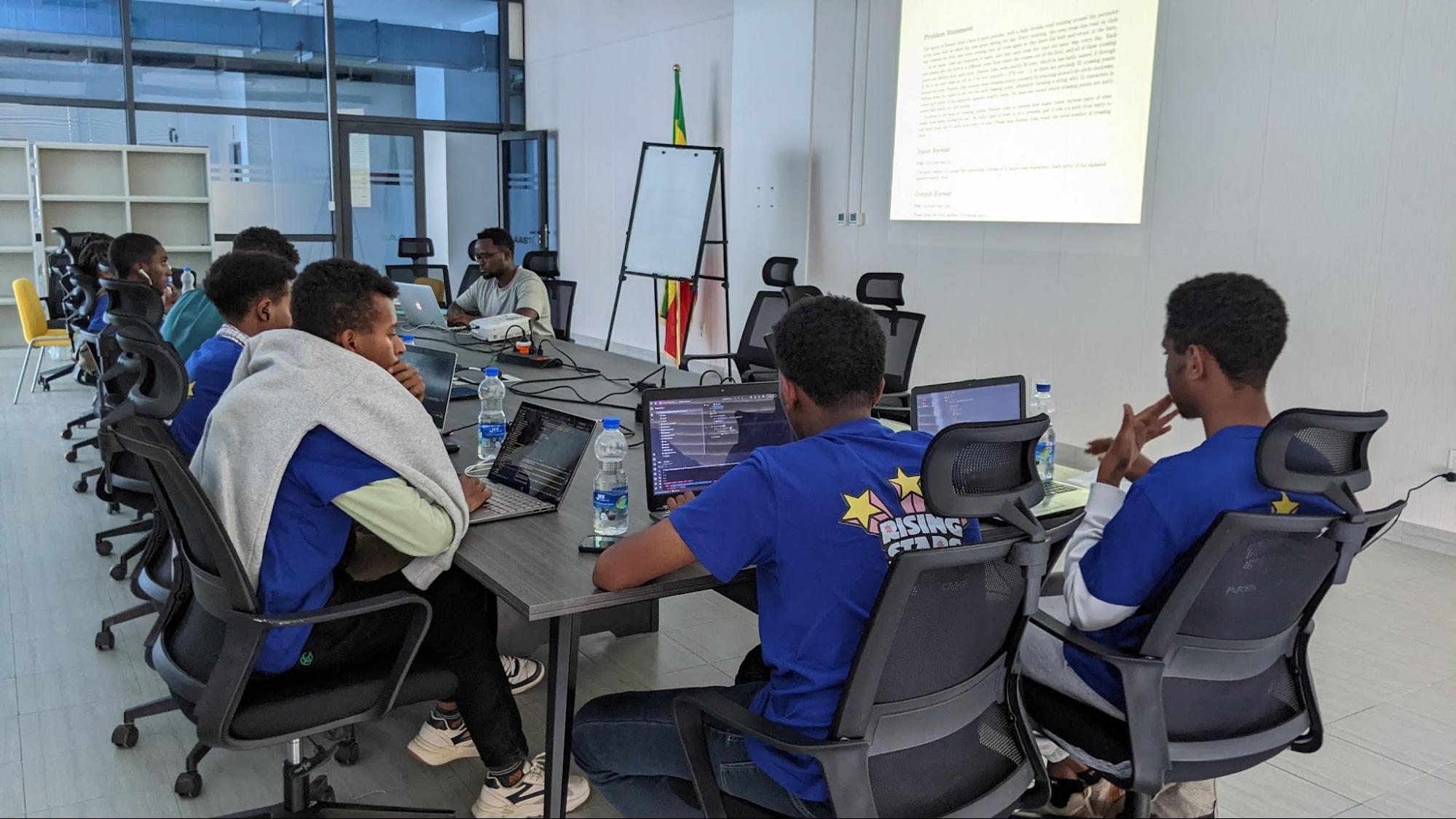
This brings us back to that Saturday in September. As the students logged in, the Rwandan organizers sat in one classroom at AIMS. Each coach supervised one or two teams, monitored competition integrity, and coordinated with exam sites spread across five time zones. Challenges arose, as expected. Some teams didn’t show up at first, some connections cut out, and one country competing using mobile data had to drop out mid-competition due to internet costs.
“We used most of the storage capacity of our server after the first day, and on the second day we realized that we would run out of space and had to delete some stuff minutes before the competition [resumed]," recalls Hirwa.
The organizers worked to maintain consistent grading standards and ensure technological equity across participating countries. As Joel explained, “There are servers in America, in Europe, or in South Africa, and this creates latency differences, so then there are problems with fairness — and with a low budget, things are more scrappy.”
“It was nice that the coaches stepped up during the competition. [Executing] the whole event is about the coaches: the proctoring and monitoring,” Joel added. As the competition unfolded, the organizers in Kigali coordinated with team leaders via Discord. The Rwanda local hosting committee had trained coaches and students on how to take and submit the exam the week before.
As the Olympiad wrapped up, submissions were graded and medals awarded. Students had gained high-level competition practice. Coaches had strengthened their connections. And the organizing committees had built institutional experience. One student achieved a perfect score — Mina Gayed of Egypt, who had earned a silver medal at the IOI a couple of months earlier and will be heading to MIT this fall.
The competition had spanned every part of the continent — Algeria, Djibouti, Egypt, Ghana, Kenya, Libya, Mali, Morocco, Nigeria, Rwanda, South Africa, Tunisia, Zimbabwe — and guest country Pakistan.
The Pan-African Informatics Olympiad is at a pivotal moment. A second successful edition is the crucial next step on the path from a one-time event to an established institution. The competition is expanding — from 66 to 119 students registered, and with new teams joining such as Botswana, Cameroon, Ethiopia, Lesotho, and Uganda.
Adding a hybrid in-person component shows growing hosting capacity. “Africa should have the same organizational capacity to host big, meaningful Olympiad events that change lives, as well as the academic capacity to ensure those competitions are rigorous and the students really succeed,” says Arun, co-founder of African Olympiad Academy, the host of PAIO 2026.
In-person events help both students and coaches deepen their networks, fostering a more cohesive informatics community continent-wide. The Global Talent Fund is providing direct support to PAIO via an Olympiad Grant. This is in addition to the GTF Coaches training that many PAIO countries’ coaches have taken — a rigorous live online 8-session course running multiple times each year. While the curriculum focuses on Olympiad mathematics, topics like discrete math and graph theory carry directly into informatics. And the training in leadership and organizational management helps coaches to build Olympiad programs for any discipline.
The PAIO organizers’ vision is to establish a recognized, rigorous international competition — a formative event that cultivates and celebrates talent and dedication. They aim to bring together bright minds, challenge them, and ignite cultural and scientific exchange across the continent. And they are well on their way to achieving all of this.
Challenges will doubtless arise in this new hybrid competition and beyond. But PAIO’s organizers are equipped with a realistic mindset and enjoy solving problems for fun. As Hirwa Arnold, Chair of the International Committee, said, “PAIO 2026 is going to be one of the success stories of the African continent that will be told in the 21st century and beyond.


