


The quest for excellence continues through bombing and blackouts
By Zarina Kodyrova, a program manager at the Global Talent Fund. Kodyrova’s work focuses on supporting exceptional young mathematical and scientific talent. She has also helped organize Ukraine's mathematical Olympiad program for more than eight years, including as deputy leader of Ukraine's International Mathematical Olympiad team, organizer of national Olympiads and training camps, and contributor to the development of mathematics education in Ukraine. She conducted video interviews and additional research for this story.
Part 1 of 2
When Russia launched its full-scale invasion on February 24, 2022, Yulia Zdanovska was with her family in Kharkiv. A 21-year-old silver medalist at the 2017 European Girls' Mathematical Olympiad and recent graduate of Kyiv National University, she had recently begun teaching through the Teach For Ukraine program. As the fighting commenced, she immediately volunteered to help in the city administration. Just a few weeks into the war, a Russian missile struck the building, killing her.
Her life is now memorialized in Yulia's Dream, an initiative by the Massachusetts Institute of Technology (MIT) supporting young mathematicians. In Ukraine, a national Olympiad for fifth-graders has been organized in her honor. Yulia’s story is also the story of the mathematical community she came from — and hoped, as a teacher, to strengthen. That community is now fighting to preserve and nurture the next generation of Ukrainian mathematical talent.
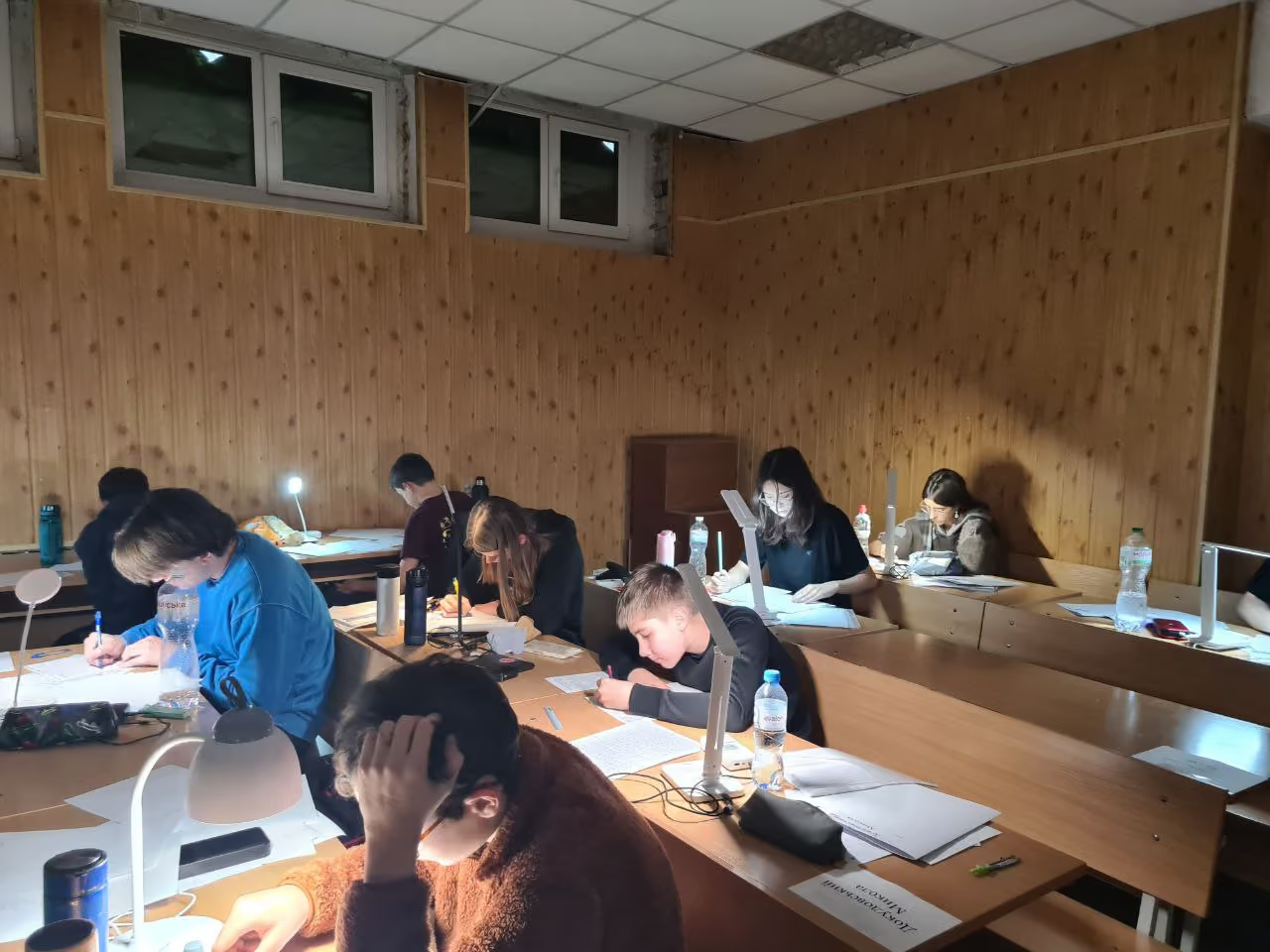
While students in most countries prepare for the International Mathematical Olympiad (IMO) in quiet classrooms, Ukrainian teenagers solve geometry proofs in bomb shelters, attend training camps interrupted by air raid sirens, and study during rolling blackouts.
Yet thousands of Ukrainian students continue competing in mathematics Olympiads each year, supported by a system that has had to adapt repeatedly since the full-scale invasion. Ostap, an 11th-grader studying for the IMO, and Bogdan Rublov, a leader of Ukraine's IMO team since 2012, shared what it is like to study in the shadow of war and what the country’s strong Olympiad tradition means to them.
Ukraine's Olympiad tradition
The International Mathematical Olympiad is the leading global competition for pre-university mathematics students. Each July, six-student teams from over 100 countries gather to solve six novel problems requiring creativity and persistence. Ukraine has participated independently since 1993, amassing 182 medals and ranking 15th globally by medal count.
The country's Olympiad ecosystem extends far beyond the IMO. Ukraine has built a comprehensive pipeline to identify and develop mathematical talent through regional competitions, national Olympiads, and specialized training programs. Before the war, hundreds of students attended in-person training sessions weekly.
An annual summer camp brought together many of the nation's brightest young mathematicians for intensive preparation. Rublov, who also chairs the jury of Ukraine's national mathematics Olympiads, has watched that camp shrink and rebuild.
"In the best years, before the full-scale invasion, we had 240 to 260 children," he says. "Now we consider it a great result that 150 children from all over Ukraine still come." Few leave dissatisfied, he adds — Kyiv's parks, museums, and summer activities give the camp something beyond mathematics to offer.
Ukrainian teams competed not only at the IMO but also at the European Girls' Mathematical Olympiad (EGMO) and the Romanian Masters of Mathematics (RMM). In 2019, Ukraine hosted the EGMO, showcasing its organizational capacity and commitment to mathematics education.
Ukraine's performance reached a peak with a fourth-place finish in 2018. The team maintained strong results, placing 11th in 2019 and 2020, then rising to 6th in 2021. Ukrainian students have achieved perfect scores multiple times, most recently in 2022.
The toll of destruction
The war’s immense human costs — more than 64,000 civilian casualties, 3.7 million people displaced inside Ukraine, and 5.9 million living as refugees abroad — include the disruption of education. Learning has been impacted for more than 6.4 million school-aged children — nearly the entire school-age population — with many teachers among the displaced as well, according to UNESCO.
The nation’s education facilities have also suffered extensive disruption and physical damage. According to a Kyiv School of Economics report from February 2026, which documents the impacts of the war, 3,800 educational institutions have been destroyed or damaged as a result of hostilities.
Even though active hostilities were carried out in 11 regions, educational institutions were damaged in 21 regions of Ukraine. The greatest losses from the destruction and damage to educational institutions are in Donetsk, Kharkiv, Kherson, Mykolaiv, and Luhansk regions.
Total damages to educational institutions exceed $17.7 billion and have reached nearly every part of the country. Kharkiv region, a stronghold of mathematical talent, faced relentless bombardment.
Adapting under pressure
Mathematical Olympus, the organization coordinating Ukraine's IMO preparation, immediately confronted a colossal challenge: how to maintain elite mathematics education when the very concept of gathering young people in one place carried substantial risk.
For the first two years, all Olympiad training shifted entirely online. Power outages caused by Russian targeting of civilian infrastructure became the new normal. Students would lose internet connectivity mid-problem, their screens going dark just as they approached a solution.
But the most significant loss was intangible. Although Olympiads revolve around mathematics, they retain a competitive edge similar to that of sports. In the classroom, students motivate each other by observing each other's progress — seeing a peer solve a problem often sparks a drive to push harder.
To address the limitations of online learning, Mathematical Olympus took calculated risks. They expanded from one major annual training camp to four. Three camps now operate in western Ukraine, farther from active combat zones, while one continues in Kyiv.
All facilities must have functioning bomb shelters and, where possible, backup generators. Classes regularly move to shelters during air raid alerts. Overnight stays in shelters have become routine.
Ostap, an 11th-grader at Kyiv's Ukrainian Physics and Mathematics Lyceum (UFML), is set to compete for Ukraine at IMO 2026 in Shanghai. He describes the routine matter-of-factly. His school's shelter — repurposed years ago from what he believes was a civil-defense firing range — now holds full classes, complete with desks and chalkboards, "lined up one after another, very close together."
During the final of the national Mathematical Battles tournament, a camera crew had arrived to film the closing ceremony when a siren interrupted the event twenty minutes in.
As Rublov recalls, "All the children, all the participants, all the jury went down to the shelter. The camera operators filmed it all with a bit of surprise — but also, I think, some optimism — watching everything just continue anyway."
He describes how similar disruptions affected this year's IMO selection round, with organizers moving the exam into a shelter from the outset and asking students to bring battery-powered lamps. "The children wrote for four hours out of four and a half, and with half an hour left the power went out, so they finished writing by lamplight," he says. "It was fine — they even had fun with it."
Weeks later came what he calls one of the heaviest bombardments of Kyiv to date, arriving the night before students from across the country were due for two more rounds of the same selection process.
"Electricity gone, water gone, everything gone," he says. Staff — mostly university students who run the program's day-to-day logistics — worked through the night confirming that every family had been reached, and asking arriving students to bring bottled water for toilets and handwashing.
"There's no problem that can't be solved," he says. "Instead, we find understanding — the children themselves understand this is being done for them, and how hard it is for us."
To keep Ostap going, his father invested in backup power stations and a second internet provider. But he says students living in his lyceum's dormitory have had a harder time. Unreliable dorm wiring often can't support even a space heater or charge a power bank. Lessons have been affected too.
"Just recently, at Polonsky Circle, we had to run two or three sessions in near-total darkness, just using phone flashlights," he says. "A couple of times the instructors solved the problem with electricity by moving to a nearby co-working space that had a generator running."
Despite these hardships, Ukraine has continued to develop talent at scale. Mathematical Olympus ran over 30 math events at city, national, and international levels, reaching 3,500 students from fall 2024 through August 2025. The organization delivered 60 lectures through 14 instructors and conducted three national training camps with four selection rounds for the IMO team.
The program also enhanced its international competition schedule, regularly attending the prestigious CAPS tournament in Austria and adding the Junior Balkan Mathematical Olympiad in 2024. Mathematical Olympus supported Ukrainian participation in six international contests in 2025, including the IMO in Australia.
These camps and competitions provide both preparation and psychological respite. As Ostap says, describing one of the organization's camps far from the front lines, "As soon as I arrive in Truskavets, I basically switch off the part of my brain that's tracking air raid alerts in Kyiv." Strikes near the town have been rare enough that he isn't sure that even one has landed there during the entire war.
"You're completely unplugged from Kyiv. You're in a purely mathematical environment for a week and a half, two weeks, surrounded only by friends who do Olympiads too. I love these camps not just for the preparation — it's the social side of it too."
Ukraine’s Olympiad system has survived because of students like Ostap and leaders like Rublov. Yet preserving existing programs is only part of the challenge. In Part 2, we’ll examine how Ukraine is widening access to its Olympiad system, responding to talent moving abroad, and trying to rebuild the pipeline that will shape its mathematical future.
Part 2 of this story is now available here.


