

Part 2 of 2:
For those in the non-academic world, summer has been over for a while. Depending on where you are in the world, temperatures are either going up or down, leaves are either blooming or burning with autumnal color.
Change is in the air, and as students begin to trickle back to university to resume their studies, it signals the start of a new term and a definitive full stop to the summer break.
In Part 1 of this story, we found Sida Li consuming bagels and wrestling with problems in linear algebra and tensors at the NYC Discrete Mathematics Research Experience, while Ervin Macic took on a machine learning summer school double header in Sarajevo and Split.
Today, we dive into coding, twin primes, and AI algorithms that are changing the world as we know it—just another typical, easy-going summer break for the Global Talent Fund’s BIG Scholars.
Code in London & twin primes in Bonn
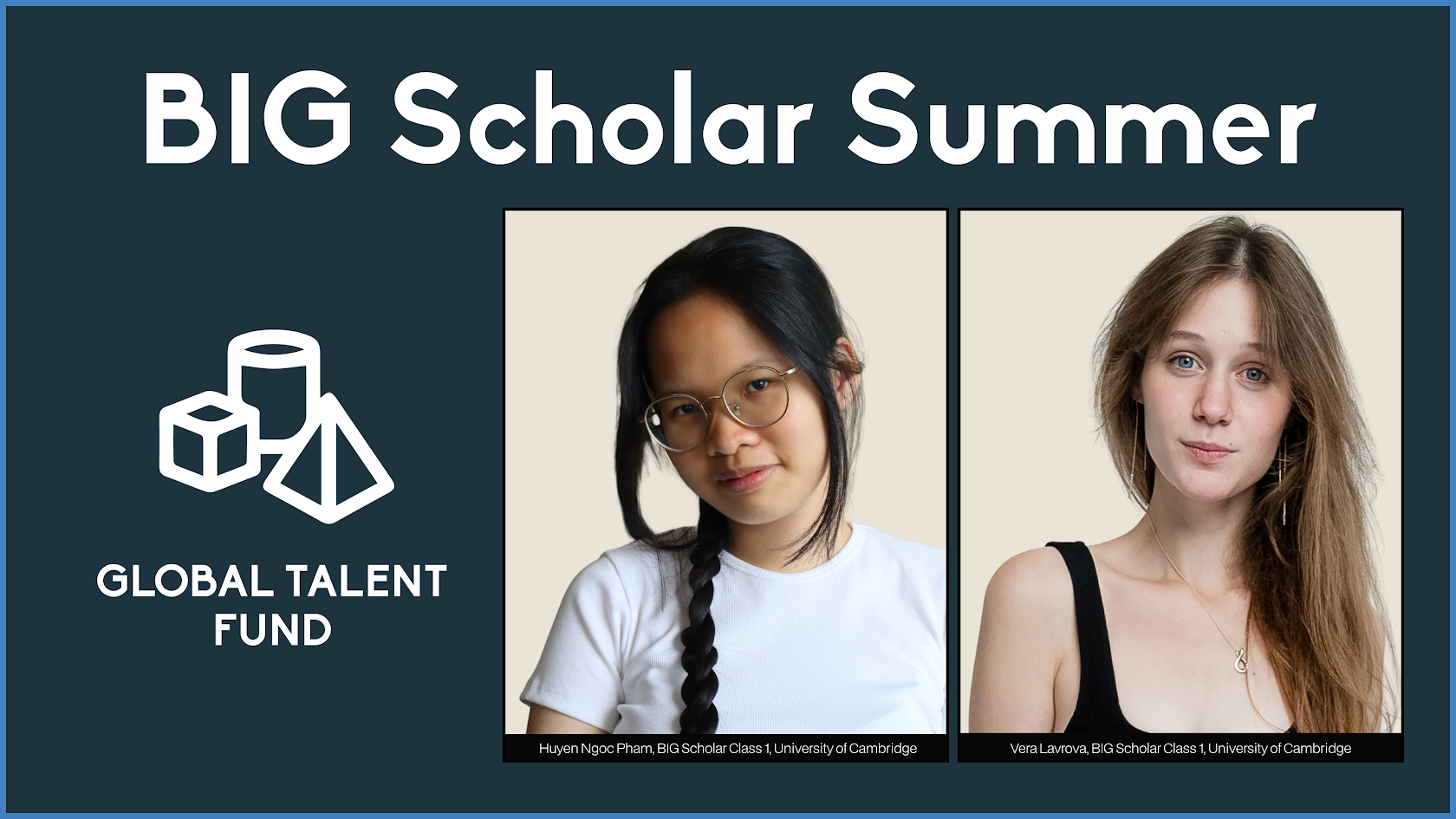
“I’m just a normal person, even though I work and study a lot,” says Vera Lavrova, a BIG Scholar reading Mathematics at Trinity College, Cambridge.
Perfectly normal—except that her idea of a great summer is two internships, a new city, and a detour into pure math research.
“Studying for me is like a full-time job,” she adds. “I think (for now, at least) my meaning of life is discovering the world and its connections. That’s partly why I study mathematics—it’s like its own world.”
When GTF announced a set of internships exclusively available to BIG Scholars in March, Vera didn’t hesitate. She applied to three and landed a Data Analyst role at Marshmallow Insurance—her first internship and the company’s first time hosting interns in that capacity.
“It was a new experience for all of us,” she says, “But it wasn’t busywork. I worked on an end-to-end project—updating a key parameter—doing the data research, computing the data, and then building the machine-learning model.”
She learned how to use Python, SQL, and Snowflake from scratch and went from a coding novice to writing over a thousand lines of code, an achievement she described as “absolutely amazing.” Yet the human side of the internship made perhaps an even bigger impact.
“I realised how much I like talking to people, getting feedback, and exchanging ideas. I’m much more extroverted than I used to be. I gained lots of confidence that I can be useful to others.”
That ethos carried through at Marshmallow: “We weren’t treated as ‘special’ interns; we were part of the team.” Even the simple rhythm mattered: “Getting up, going to work, coming home—that 9–5 experience taught me a lot.”
And of course, there was the thrill of the UK’s capital.
“I loved it so much more than I expected—old buildings next to brand-new ones; museums and galleries everywhere, and most importantly, people. Everyone is different but slightly lost and not fully sure about how to live life – and that helps me not to feel lonely in my fears and anxiety about the future.”
Her second placement was closer to home and took a sharp turn into pure mathematics. The Max Planck Society has a long and storied history of conducting research in the natural, life, social, and human sciences. It currently counts 20 Nobel Prize laureates among its ranks, so getting an internship is far from easy.
After emailing the Max Planck Institute for Mathematics in Bonn to request an exception (they don’t usually take cold applications), Vera joined a research group where senior scientists offloaded real sub-problems from larger projects.
“These were genuine questions, not artificial tasks,” she said. “I’m working in analytical number theory, reading papers, and trying to improve certain boundaries in theorems related to twin primes. Prime numbers are those that can only be divided by one and themselves. Sometimes, two primes differ by only two—for example, 11 and 13, or 239 and 241. We still don’t know whether there are infinitely many such pairs – this is the so-called “twin prime conjecture.”
It sounds intensely theoretical, but studying twin primes helps reveal hidden patterns in how numbers behave, deepening our understanding of mathematical order and randomness. Research strengthens fields like cryptography and computing, shaping the technology that underpins modern life.
Together, the internships brought clarity. “I learned what I’m good at and what I can improve. I don’t know exactly what I’ll do yet—the world changes too fast—but I’m sure I can find a job I love, not just one I’m handed.”
Vera is frank about the first-year path and its obstacles. “It’s usually not efficient to apply for internships after the first year—big companies prefer later-stage students, which is sad because many highly motivated first-years are ready.”
Her workaround: apply widely, ask boldly, and create your own luck.
“I’m not the kind of person who needs to change the world or start a groundbreaking new company, but I want to make the world better locally,” she says. “Spread a little love. Do work that helps.” And Cambridge? “Magical. Sometimes it feels like Hogwarts. Studying here was always a dream—and now I’m living it.”
Modeling and growing across 11 time zones
Huyen Ngoc Pham, another BIG Scholar studying Mathematics at Trinity College, Cambridge, spent her summer working with Yale professor Stefano Giglio. The question that sparked Huyen’s internship was deceptively simple—could artificial intelligence learn to replicate the way experts think about complex research?
“We trained the model to approximate human scientific judgment,” Huyen explains. “It was fascinating to see how close it could get—and where it struggled.”
The work didn’t end with model performance. For Huyen, the project was also about perspective. “AI is everywhere,” she reflects. “It’s too powerful to ignore. This feels like the next technological leap, and I know it’s going to shape how I work and think.”
The internship ran fully remote: Huyen in Vietnam, her supervisor in the United States, separated by 11 hours. That gap forced growth. “It definitely improved my confidence. I knew he wouldn’t be available if I got stuck, so I took more initiative. I prefer group work, but I actually found that I grew faster when I worked alone.”
The week had a rhythm. “We’d meet once: I’d explain what I did, the problems, and possible fixes. We’d choose the next path. Then I had three to four days of deep work—reading, choosing which algorithm to implement, coding, debugging, checking functions, patching.”
That cycle lasted two and a half months and rewired how she uses time. “I had a mindset shift. I used to spend time on things that wouldn’t make the final product. This taught me to optimize for what matters.” Or, as she puts it more simply: “Knowledge is infinite—but I need to focus on what I can apply.”
The role was another of the dedicated internships for BIG Scholars. Huyen raised her hand, got the shot, and made the most of it. Now she’s clearer on how she wants to work. “My time management has gotten much better. In the first year, I tried too many things. Next year I want to focus on a few.” As for the long view: “I still want to do a master’s. I’m not a fan of detailed long-term plans—life changes quickly.”


